Sitamarhi
📍 Bihar, India
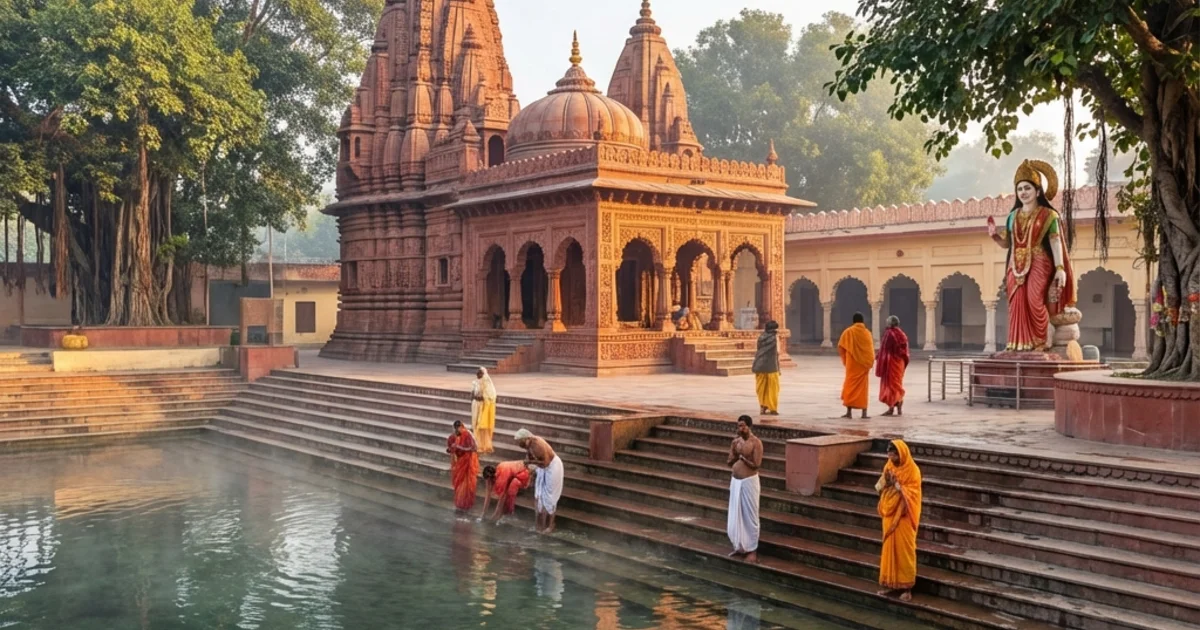
Sitamarhi, a sacred district in the northern part of Bihar, is revered by millions as the hallowed birthplace of Goddess Sita, the female protagonist of the epic Ramayana and the epitome of grace, resilience, and virtue in Indian culture. The primary focus of devotion in this historic town is the Punaura Dham, situated just a few kilometers from the main city center. According to ancient lore and local tradition, it was at this very spot that Raja Janak, the philosopher-king of Mithila, was performing a ritual ploughing of the earth during a catastrophic drought. As the blade of his plough (sita) struck a golden vessel buried in the soil, he discovered a celestial infant, whom he named Sita and raised as his own daughter. To commemorate this divine event, a magnificent temple stands today, surrounded by a sacred pond known as the Janaki Kund, where it is believed the infant Sita took her first bath. The spiritual significance of Sitamarhi permeates every corner of the district, with several other related sites such as the Haleshwar Sthan, believed to have been established by Raja Janak himself to worship Lord Shiva. The city transforms into a vibrant hub of religious activity during the festival of Ramanavami and Vivah Panchami, where the tales of Sita’s birth and her wedding to Lord Rama are retold through folk songs and theatrical performances like the Ramlila. For Maithils, Sitamarhi is not just a geographic location but a symbol of the region's contribution to the moral and spiritual fabric of India. The local culture is deeply intertwined with the identity of 'Janaki', influencing everything from the dialect of Maithili spoken here to the intricate motifs in local Madhubani paintings. Ongoing archaeological and development efforts, such as the Ramayana Circuit, aim to preserve and showcase Sitamarhi's rich heritage to the world, ensuring that the legacy of the 'Daughter of Mithila' continues to inspire future generations with her message of strength and devotion.
Contributed by
Explore More Heritage Sites
Swipe to explore related heritage stories, audio, art & traditions

Janakpurdham
Janakpurdham, the legendary capital of the ancient Videha Kingdom, stands today as one of the most significant spiritual and cultural landmarks in the entire Mithila region. Spanning across the border into modern-day Nepal, this sacred city is immortalized in the Ramayana as the birthplace of Goddess Sita, the daughter of Raja Janak. The crown jewel of Janakpur is the magnificent Janaki Mandir, a sprawling architectural masterpiece built in 1910 by Queen Brisabhanu Kunwari of Tikamgarh. This temple, often called the 'Nau Lakha Mandir' due to its nine lakh rupee construction cost, is a stunning example of Mithila-Rajput architecture, featuring intricate marble carvings, white domed arches, and vibrant internal shrines dedicated to the divine couple, Ram and Sita. Beyond its architectural beauty, Janakpurdham is the site of the ancient 'Rangbhoomi', where Lord Rama is believed to have broken the celestial bow of Lord Shiva to win the hand of Sita in marriage. This event is celebrated annually with immense fervor during the Vivah Panchami festival, attracting hundreds of thousands of pilgrims from across the globe. The city is also a vibrant center of surviving Mithila arts, with local women continuing the ancient tradition of wall painting and mural art that can be seen throughout the town's narrow lanes. For many, Janakpur represents the soul of the Videha civilization—a place where the ideals of dharma, sacrifice, and philosophical inquiry once flourished under the patronage of the Janakas. The spiritual atmosphere of Janakpur is complemented by its numerous sacred ponds, such as the Ganga Sagar and Dhanush Sagar, which are central to the daily life and religious rituals of the Maithil people. Whether as a site of profound archaeological interest or as a beacon of living Hindu tradition, Janakpurdham remains an essential pilgrimage, bridging the gap between historical fact and mythological timelessness, and serving as a testament to the enduring cultural bond between India and Nepal.
📍 Nepal

Madhubani
Madhubani, whose name literally translates to the 'Forest of Honey', is globally celebrated as the beating heart of Mithila's artistic and cultural renaissance. Located in the northern plains of Bihar, this district has gained worldwide fame for its unique and vibrant tradition of Madhubani Painting, an ancient art form that was once restricted to the mud walls of village homes but has now found its way into prestigious international galleries and prestigious national awards. The art form is characterized by its bold use of natural colors, eye-catching geometric patterns, and themes largely derived from Hindu mythology, nature, and the local daily life. Key villages like Jitwarpur and Ranti have become living open-air museums where almost every household participates in this creative legacy, which was traditionally passed down from mothers to daughters for over three millennia. The origins of this art are said to date back to the time of the Ramayana, when Raja Janak commissioned local artists to decorate the entire city for the wedding of Ram and Sita. Beyond its world-renowned paintings, Madhubani is also famous for its 'Sikki' grass crafts, where women weave golden-colored wild grass into beautiful domestic items, and its unique 'Sujani' embroidery, which tells stories through stitch-work. The district is a land of lush green fields, numerous sacred ponds (pokhars), and a deeply rooted agrarian society that celebrates its festivals like Chhath and Madhushravani with unparalleled zeal. Madhubani also holds significant historical value, with sites like the Saurath Sabha Gachhi once serving as a major center for Vedic scholarship and matrimonial selection. Today, the town is a bustling center of Maithil identity, where the ancient language of Maithili is spoken with pride and the traditional hospitality of the region remains unchanged. For travelers and art enthusiasts, a visit to Madhubani offers a rare glimpse into a civilization that has successfully preserved its creative soul while adapting to the modern world, making it a true 'cultural capital' of rural India.
📍 Bihar, India

Darbhanga
Darbhanga, often referred to as the 'Cultural Capital of Mithila', is a city that perfectly encapsulates the aristocratic grandeur and intellectual depth of the region's past. For centuries, it served as the royal seat of the Khandavala dynasty, popularly known as Raj Darbhanga, whose Maharajas were among the wealthiest and most philanthropic rulers in colonial India. The city's skyline is dominated by architectural marvels like the Nargauna Palace, a unique seismically-resistant palace built after the 1934 earthquake, and the imposing Raj Quila (Darbhanga Fort), whose red sandstone walls were inspired by the Red Fort in Delhi. Darbhanga’s contribution to education and music is monumental; the Maharajas established some of India's earliest modern schools and universities, and their court was a legendary center for the 'Darbhanga Gharana' of Dhrupad music, which remains one of the oldest and most prestigious schools of Indian classical music. The city is also a major center for spiritual life, home to the famous Shyama Mai Temple built on the royal cremation grounds, and various other shrines that reflect the region's unique blend of Vedic and Tantric traditions. Geographically, Darbhanga is characterized by its numerous historic ponds—many of which were excavated by the royal family to combat droughts—and its vibrant local markets famous for 'Makhana' (fox nuts) and 'Maachh' (fish), which are the hallmarks of Maithil cuisine. The city is also a significant rail and air hub (Darbhanga Airport), connecting the heart of Mithilanchal to the restland of India. Whether it is the soulful rendition of a Vidyapati song in a local 'baasa' or the sight of the majestic fort walls at sunset, Darbhanga offers a profound journey into a legacy where royalty, religion, and the arts have thrived together for generations. It remains a focal point for the preservation of Maithili literature and the Tirhuta script, ensuring that the intellectual torch of ancient Videha continues to burn bright in the modern era.
📍 Bihar, India

Ahilya Sthan
Ahilya Sthan, situated in the Ahiyari village of Darbhanga district, is a site of immense mythological and spiritual significance, famously associated with one of the most poignant episodes of the Ramayana. The temple is dedicated to Ahilya, the wife of the great sage Gautama, who was turned into a stone by a curse and remained in that form for thousands of years. According to the epic, as Lord Rama was traveling to Janakpur with Sage Vishwamitra and his brother Lakshmana, the dust from his feet touched the stone, liberating Ahilya and restoring her to her human form. This event is celebrated as a symbol of divine grace and the restorative power of the divine. The current temple structure, though periodically renovated, maintains an aura of ancient sanctity, with its sanctum containing a symbolic stone slab revered as the form of Ahilya before her liberation. The village itself is named Ahiyari in her honor and has been a center of pilgrimage for centuries, especially for those seeking spiritual purity and redemption. Beyond the temple, the surrounding landscape is marked by several ancient banyan and peepal trees, which local traditions believe date back to the Vedic era. The site is a focal point during the Ramanavami festival, where devotees gather to offer prayers and recite the Ramayana. For the people of Mithila, Ahilya Sthan represents the region's deep connection to the life of Lord Rama and serves as a reminder of the transformative power of faith and the sacredness of the earth that once bore the footsteps of the divine. It also highlights the intricate weave of mythology and geography that defines the Maithil landscape, where every village has a story that links the local to the eternal.
📍 Darbhanga, India

Simraungadh
Simraungadh, located in the Bara district of modern-day Nepal, was once the formidable and glorious capital of the Karnata Dynasty, which ruled Mithila from the 11th to the 14th century. Often referred to as the 'Hampi of Mithila' due to its extensive archaeological ruins, this lost city represents the pinnacle of medieval Maithil architecture, fortification, and cultural refinement. Founded by King Nanyadeva in 1097 CE, Simraungadh was designed as a sophisticated fortress city surrounded by seven layers of deep moats and high mud walls, making it nearly impregnable to outside invasions for over two centuries. The city flourished as a major center of Vedic learning, music, and the arts, with its rulers being great patrons of scholars and poets. The ruins today, though scattered, include the foundation of massive temples, stone sculptures of exquisite craftsmanship (Pala-Sena style), and intricate brickwork that hints at the city's former splendor. The most iconic landmark is the shrine of Isra Devi, the family deity of the Karnata kings, which still attracts local devotees. Archaeological excavations have revealed advanced water management systems and urban planning that were far ahead of their time. The fall of Simraungadh in 1324 CE at the hands of Ghiyasuddin Tughlaq marked a tragic turning point in Mithila's history, leading to the migration of its elite and the eventual decline of the city into ruins and forest. For historians and Maithil nationalists, Simraungadh remains a powerful symbol of the region's sovereign past and its golden age of cultural achievement. It serves as a stark reminder of the rise and fall of great civilizations and continues to be a site of ongoing research as scholars attempt to reconstruct the full narrative of the Karnata legacy that once united the plains of Bihar and the foothills of Nepal under a single cultural banner.
📍 Nepal

Vaishali
Vaishali, situated in the fertile Gangetic plains of modern-day Bihar, holds a monumental and pioneering status in the annals of global civilization, famously recognized as the cradle of the world's first republic. Around the 6th century BCE, long before the democratic traditions of Greece or Rome gained prominence, the Vajjika League, dominated by the vibrant and powerful Lichchavi clan, established a decentralized, collective form of governance. This sovereign state was administered by an elected assembly of representatives, marking a revolutionary shift from absolute monarchy to a system rooted in public discourse and shared decision-making. This political innovation transformed Vaishali into a flourishing metropolis, a beacon of intellectual freedom, trade, and cultural vitality that echoed across the Indian subcontinent. The spiritual heritage of Vaishali is as profound as its political legacy, serving as a hallowed ground for two of the world's major religions. For followers of Buddhism, the city is steeped in the presence of Gautama Buddha. He visited Vaishali multiple times throughout his life, finding in its republican ethos a fertile ground for his teachings on equality and enlightenment. It was in Vaishali that the Buddha delivered his last sermon, famously declaring his impending departure from the physical world (Mahaparinirvana) to his devoted disciples. The city also witnessed the historic Second Buddhist Council approximately a century after the Buddha's passing, an event that was instrumental in codifying monastic rules and addressing early schisms within the Sangha. The majestic Ashokan Pillar, crowned with a singular, noble lion capital carved from a monolithic block of polished sandstone, stands today as a silent sentinel of this glorious era. Adjacent to it, the remains of the Buddha Relic Stupa are believed to have originally enshrined a one-eighth portion of the Buddha's bodily remains, drawing pilgrims from across the globe for over two millennia. For the Jain community, Vaishali is revered as the sanctified birthplace of Vardhamana Mahavira, the 24th and final Tirthankara. Born in the nearby village of Kundagrama into a royal Lichchavi family, Mahavira's path to spiritual liberation began in the very air of this ancient republic. This intersection of early democratic governance and profound religious discovery has imbued Vaishali with a unique cosmic energy. The archaeological complex, featuring the 'Raja Vishal ka Garh'—the ancient assembly hall of the Vajjis—serves as a tangible link to a time when humanity first experimented with the power of the collective will. Today, Vaishali remains not just a site of ancient ruins, but a living testament to the enduring human quest for justice, liberty, and the ultimate truth, bridging the gap between the mundane world of politics and the eternal realm of the spirit.
📍 Bihar, India